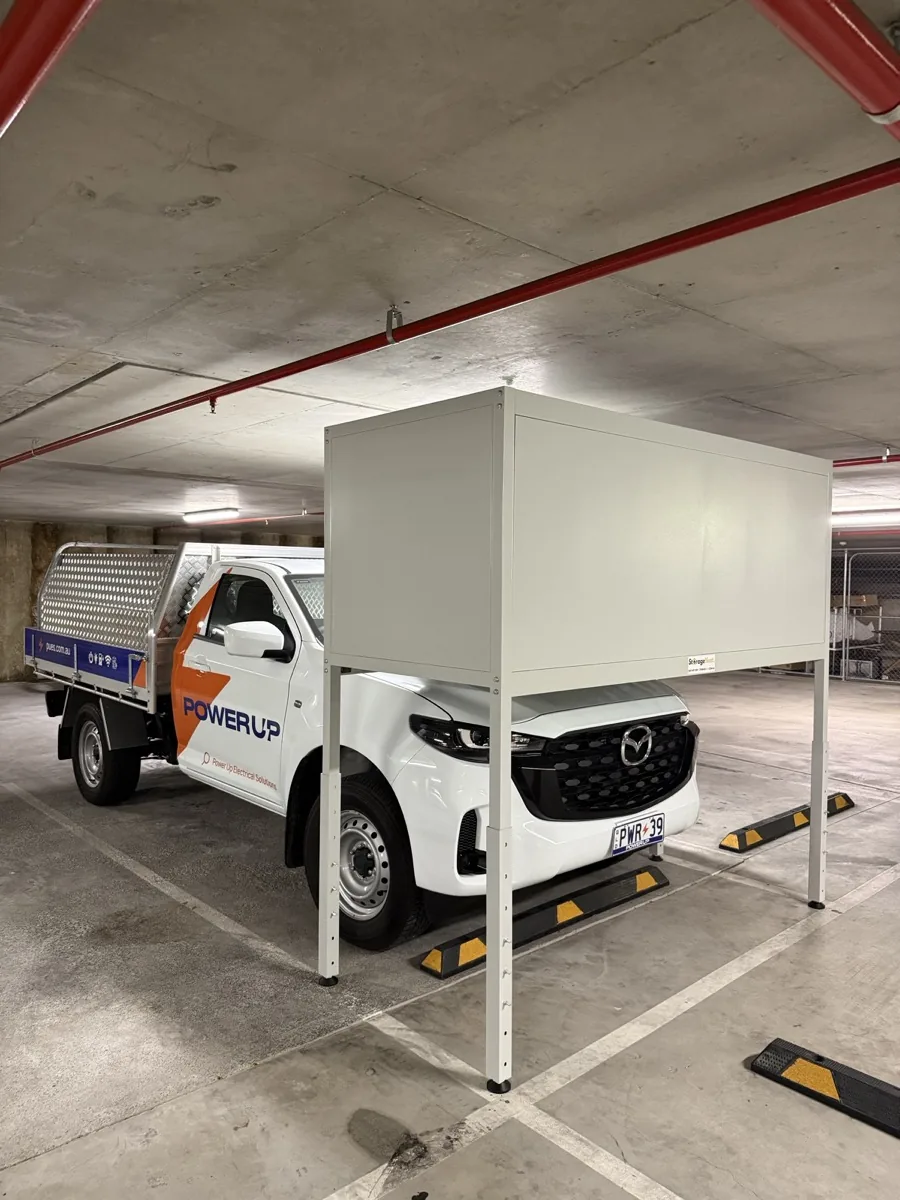
How much overhead clearance you actually need for over bonnet storage — and how to measure it properly in five minutes.
You need a minimum of 2.1 metres of clearance from the car park floor to the lowest obstruction above your bonnet. The Kookaburra's legs adjust between 2.05m and 2.35m, so it fits under most residential car park ceilings without modification. If you have less than 2.1m, the unit can still work — but your vehicle's bonnet needs to sit lower.
"Lowest obstruction" is the part people get wrong. It is rarely the ceiling slab itself. Pipes, sprinkler heads, ducting, conduit and lighting all hang below the slab, and any one of them sets your real ceiling height.
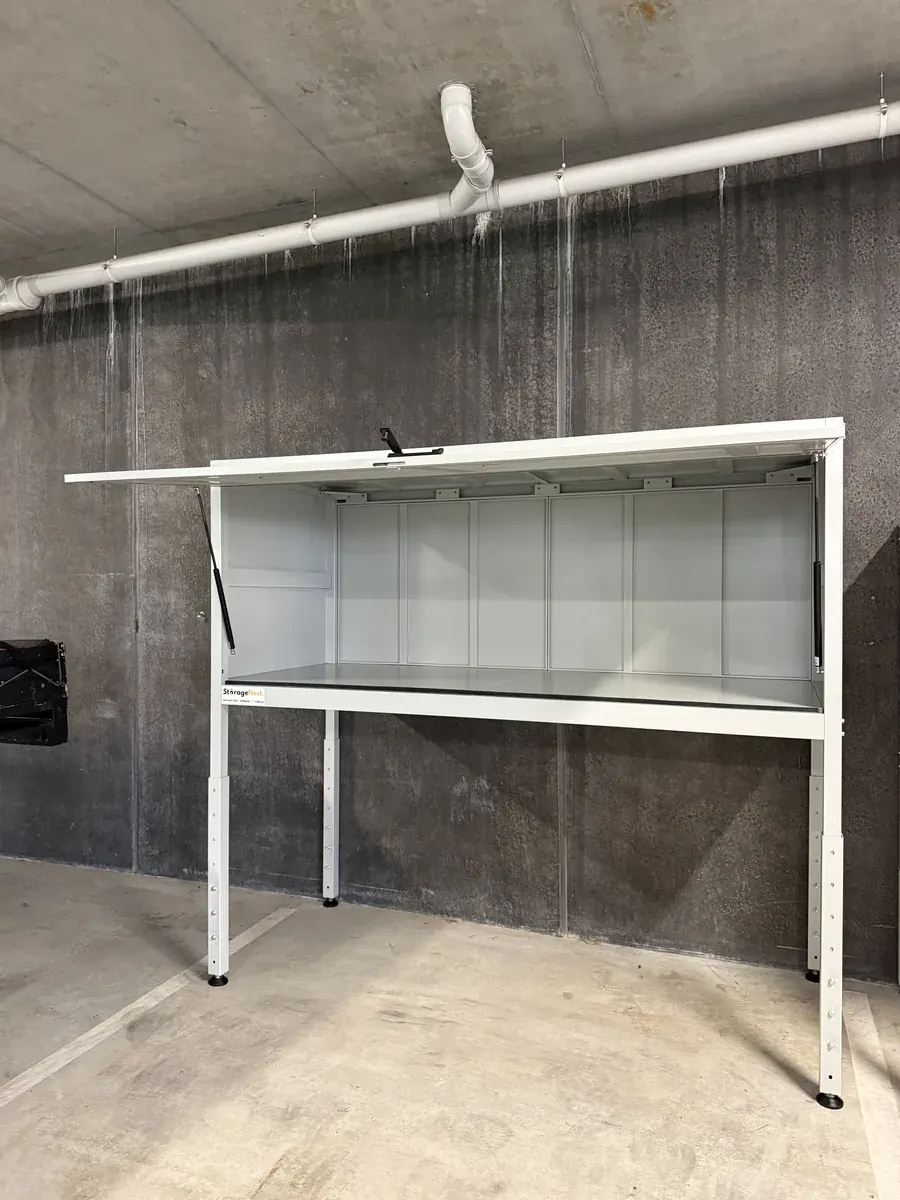
Stand where the front of your car parks. Run a tape measure from the floor straight up to the concrete above. Write this number down — it is your best case.
Now look for anything hanging below that slab within the front 2.4m of your bay: sprinkler heads, water pipes, air conditioning ducting, cable trays, downlights. Measure floor to the lowest one.
Measure from the floor to the highest point of your closed bonnet. A hatchback is typically well under a metre; a dual-cab ute or large SUV is considerably higher.
Subtract your bonnet height from your lowest obstruction height. The gap that remains is the space the storage unit has to live in. The Kookaburra's storage compartment is 1.0m deep, and it sits on adjustable legs that straddle the car rather than resting on it.
Standard fit. The unit installs at a height that clears almost any passenger vehicle, and the adjustable legs absorb sloped or uneven car park floors.
Usually workable. The legs drop to 2.05m at their lowest setting, which suits lower-bonnet vehicles like sedans and hatchbacks.
Too tight for a standard install. Send us your measurements anyway — car parks vary bay to bay and there may be a better position nearby.
Height is the constraint most people hit first, but it is not the only measurement that matters. The Kookaburra occupies:
Length, running the same direction as your car.
Width. Standard Australian residential bays comfortably accommodate this.
Overall height, adjustable via the legs.
Because it stands on its own legs, nothing touches or rests on your vehicle, and the unit does not need to be drilled or bolted into the building. That is what makes it straightforward to get past a body corporate — see our body corporate approval guide.
Most do — drainage falls are normal in basement car parks. Each leg adjusts independently, so the unit sits level even when the slab underneath it does not.
Not automatically, but it does set your working height, and fire services must never be obstructed. Measure to the sprinkler head, not the ceiling, and give us that figure.
Yes. The unit is positioned so normal vehicle access is retained. If you have a particularly tall bonnet opening arc, mention your make and model when you send measurements.
It helps, but it is not essential. Our free compatibility check walks through it with you, and installers confirm on site before anything is fitted. You can also read how the whole process works.
Send us your car park measurements and we'll confirm compatibility — usually within one business day.